

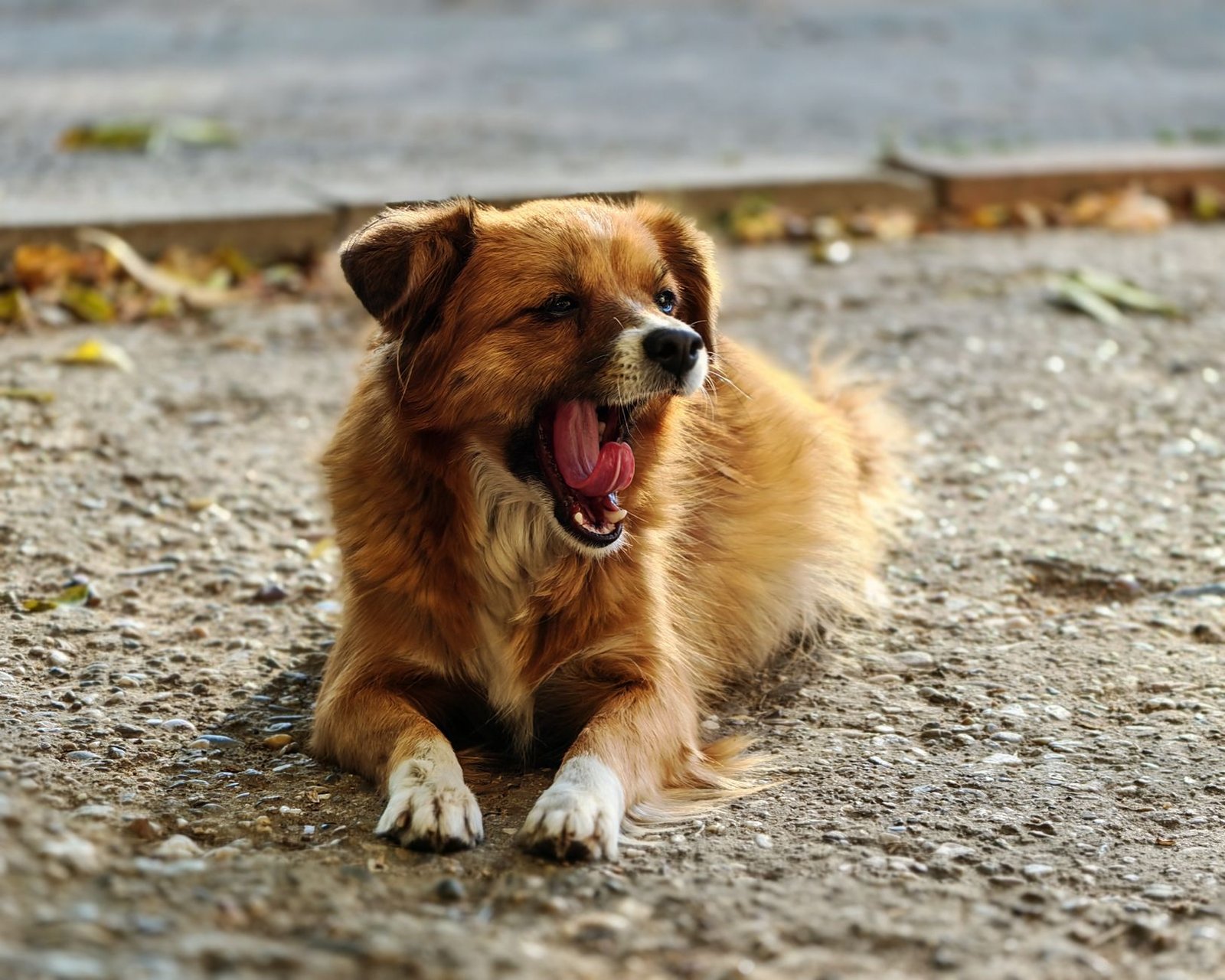
Owners come in certain they know what this is. Sometimes they are right. But a cough is a symptom rather than a diagnosis, and four quite different problems produce a noise that sounds similar across a kitchen. Telling them apart changes everything about what happens next, and most of the clues are things you can gather at home before you arrive.
The infectious hack
This is the one people assume. A harsh, honking cough in bursts, often ending with a retch that looks productive, in a dog who is otherwise bright, eating and keen to go out. It gets worse with excitement, after a drink, and when a collar presses on the throat.
The giveaway is the mismatch: dramatic noise, cheerful dog. It usually follows a few days after contact with other dogs — daycare, boarding, a grooming salon, the off-leash area — and most healthy adults shake it off over one to three weeks. The cough often outlasts the illness, so a well dog can still be honking two weeks on.
If this is what you are dealing with, keep your dog away from other dogs until the cough has settled, and let the daycare or boarding kennel know — they would far rather hear it from you.
The heart cough
This is the one that gets missed, and it is the reason this article exists.
In a dog with a known murmur, a new cough is the moment to look at the heart — but the cough itself is a weak signal. Most coughing dogs with valve changes are coughing because of their airways rather than because of fluid in the lungs, and the research is consistent that the cough alone does not tell you whether the heart has started to fail. What tells you is the breathing. Watch for a cough that is worse at night and when the dog lies down, a reluctance to settle flat, and a drop in stamina the family had already filed under getting older — then count the number below, because that is the part that actually separates a heart problem from an airway one.
It turns up most in small and medium breeds in middle age and beyond — cavaliers, dachshunds, poodles, terriers, chihuahuas — often in a dog whose murmur was noted at a routine visit a few years earlier and did not seem to mean anything at the time.
There is one number you can collect at home that is worth more than any description. Wait until your dog has been properly asleep for a quarter of an hour and is lying still, then count the breaths for thirty seconds and double it. Not while they are panting, and not during the twitchy, paddling phase of sleep — both give you a useless number, and so will a hot room. Most sleeping adult dogs sit in the teens to low twenties. Anything settling above twenty-five is worth mentioning, consistently over thirty is worth a phone call, and well over it is worth a drive. Learn the number now, while your dog is well, because the comparison is what makes it useful.
The windpipe honk
A dry, repetitive honk, often described as a goose, set off by excitement, pulling on a leash, drinking, or pressure under the chin. It typically eases when the dog calms down and is worse in heat and humidity.
This is a small-breed pattern — pomeranians, yorkshire terriers, chihuahuas, toy poodles — and it comes from the rings of cartilage in the windpipe losing their stiffness and flattening as air moves through, and from the soft band of tissue across the top of the windpipe going slack. It is frequently mistaken for the infectious cough, and the discriminator is that it has usually been going on for months, comes and goes with excitement, and nobody else’s dog caught anything.
Weight and a harness instead of a collar do more for these dogs than most owners expect.
The older dog’s chronic hack
A dry, hacking cough that has been there for months and is gradually becoming part of the dog. It is worse after exercise and worse in smoky or dusty air, and it turns up most in small breeds in middle age and beyond. The dog is otherwise reasonably well, which is why it drifts on for months before anybody raises it.
It should not. A long-standing cough in an older dog is worth one set of chest images even when the dog seems entirely well, because several of the things on that list stay quiet until they are not, and the whole point of imaging early is that you find a small problem instead of a large one.
In a bigger older dog, a dry cough that arrives with a changed bark and noisy breathing in on exertion is a different problem again — one that involves the voice box rather than the chest, and one that does badly in the heat.
Two other things belong in this section, because they do not fit the patterns above and both need prompt attention: a cough that began suddenly and violently in a dog who was fine an hour earlier, which can mean something inhaled such as a grass seed, and a cough in a dog who has become genuinely unwell — off food, feverish, breathing hard at rest — which points at the lungs rather than the airway.
What separates them in the room
The examination does most of the work: listening to the heart and the lungs separately, checking whether a murmur is present and how loud, feeling the windpipe, and watching the dog breathe at rest.
From there, chest imaging and laboratory work is what distinguishes fluid in the lungs from a thickened airway from an infection, because those three can produce a similar-sounding cough and need completely different handling. Our medical services cover the longer-term management, which for a heart case is a very different conversation from a windpipe case. A dog breathing hard at rest, with blue or grey gums, or refusing to lie down goes through urgent care the same day rather than waiting for an appointment.
What to bring with you
- The sleeping breath count, taken over a few nights if you can. It is the most useful single number if the heart is in question, and it can be perfectly normal in an airway cough — which is itself worth knowing.
- A phone video of the cough. Thirty seconds is plenty, and it saves us relying on an impression of a noise.
- When it happens. Night versus day, at rest versus excited, after drinking, on the leash.
- How long it has been going on, and whether it is worsening or steady.
- Recent contact with other dogs, and whether any of them were coughing.
- Any change in stamina, including walks that have quietly got shorter.
- Whether the dog can lie flat on their side and sleep, or now props themselves up.
Our hours
We are open Monday to Saturday from 9:00 am to 7:00 pm and Sunday from 9:00 am to 5:00 pm, which covers most evenings and both weekend days.
A bright dog with a honking cough can wait for an appointment. A dog breathing hard at rest, with a sleeping breath rate well above thirty, pale or bluish gums, or who cannot settle lying down should not wait. If that happens after we close, contact VCA Canada Vancouver Animal Emergency and Referral Centre at (604) 879-3737, 2303 Alberta Street, which is the after-hours hospital we refer to.
Common questions
My dog coughs only when pulling on the leash. Is that a problem?
It is worth mentioning, because it points at the windpipe rather than the lungs. Switch to a harness in the meantime; it costs nothing and often reduces the episodes immediately.
Can I give a cough suppressant?
Not without asking. A cough clearing fluid or material out of an airway is doing a job, and quieting it can be exactly wrong depending on the cause. Several things people reach for are also unsafe for dogs.
The murmur was found years ago and nothing happened. Does it matter now?
It matters more now, not less. A murmur on its own is often silent for years, and a new cough in a dog with a known murmur is precisely the combination worth checking rather than assuming the two are unrelated.
Do cats cough?
Cats cough far less often than dogs, and when they do it is a different list, with airway inflammation at the top of it. A coughing cat is worth an appointment rather than a wait, and owners often describe it as trying to bring up a hairball without producing one.
How long is too long to wait on a mild cough?
If a bright dog has been coughing for more than a week without improving, or the cough is changing, book a visit. If any of the breathing signs above appear, stop waiting.
Speak to the team at University Veterinary Clinic
Tonight, when your dog is asleep, count the breaths for thirty seconds and write the number down. Bring it with you, along with a short video of the cough. Those two things narrow this down faster than anything else.
Published by the team at University Veterinary Clinic.
This article is educational in nature and is not a replacement for hands-on assessment of your own pet by a veterinarian.
University Veterinary Clinic
4416 West 10th Avenue, Unit 103, Vancouver, BC V6R 2H9 (Point Grey)
Phone: (604) 224-7743
Hours: Monday to Saturday 9:00 am to 7:00 pm; Sunday 9:00 am to 5:00 pm