

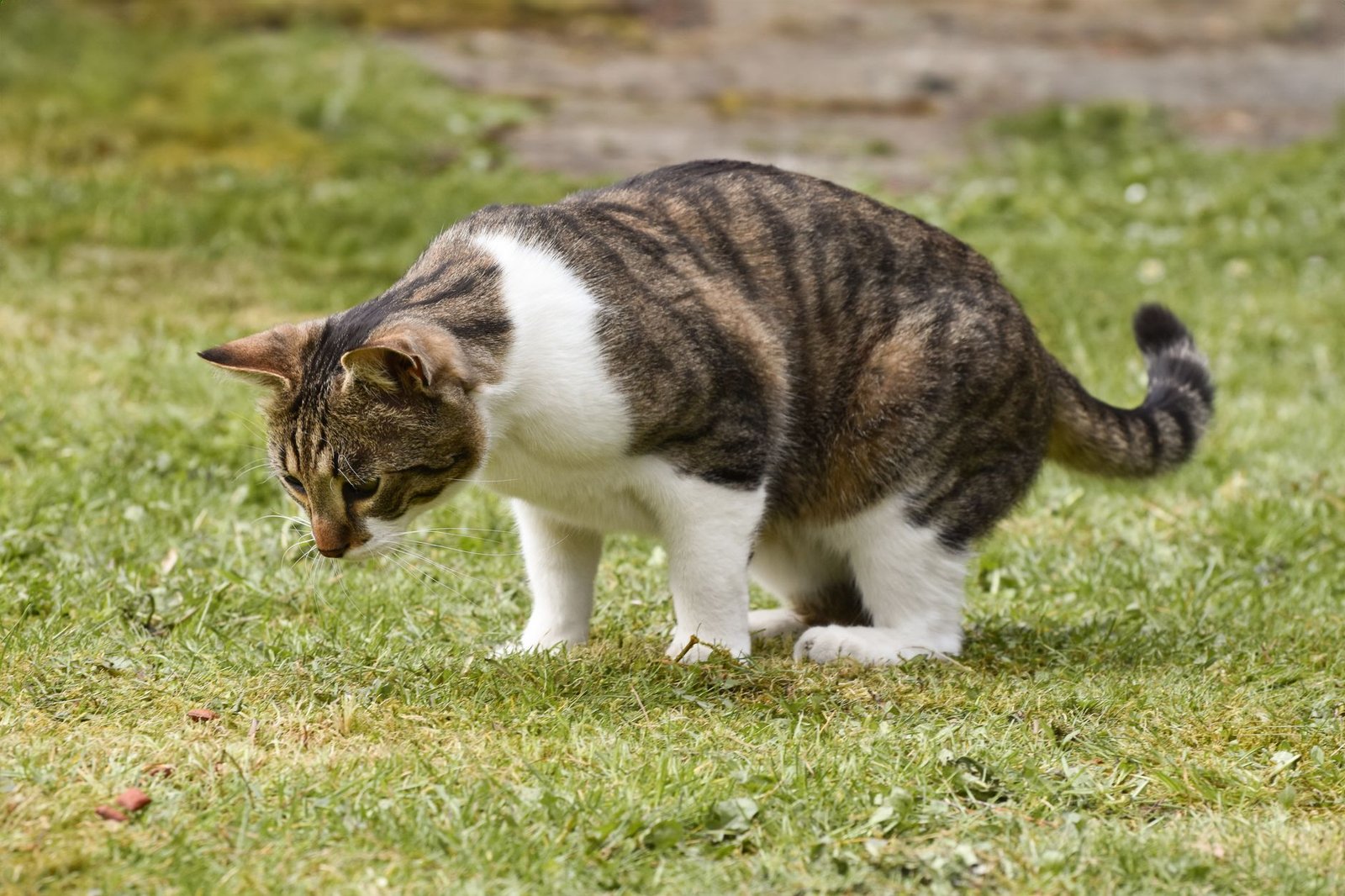
Quick answer: Constipation in cats means stool is moving through too slowly, and it usually shows up as repeated straining in the litter box rather than obvious pain. Straining can also mean a urinary blockage, which is life threatening, so a cat pushing without producing urine needs care right away. Repeated episodes can permanently stretch the colon.
Cats Are Very Good at Hiding a Slow Gut
Most cats do their business privately, often in a covered box, often on a different floor of the house from where their people are sitting. That privacy is exactly why constipation is so often caught late. A cat can spend a week producing less and less, working harder each time, and the only clue is a litter box that needs scooping less often than it used to.
The signs worth knowing are quiet ones. Fewer stools than the cat’s normal pattern. Small, hard, dry pellets instead of formed stool. Long sits in the box with nothing to show for it, or several trips in a short stretch. Stool deposited just outside the box, because the cat began to associate the box itself with discomfort. Some cats vocalize while posturing. Others start skipping meals, vomiting occasionally, grooming less, hiding more, or losing a little weight while nothing else seems wrong.
In a multi-cat home this gets harder. When two or three cats share boxes, nobody can say with confidence whose stool is whose, and a cat can slide a long way before the pattern becomes obvious. If you have more than one cat, the useful habit is scooping daily so you know what a normal day’s output looks like in total.
Straining in the Litter Box Is Not One Single Problem
This is the part that matters most, so it is worth being precise. From across the room, a cat straining to pass stool and a cat straining to pass urine look almost identical. Same crouch, same effort, same repeat visits, same worried expression on the owner’s face. The two situations are not remotely equivalent in urgency.
A blocked urinary tract is measured in hours. A cat who postures again and again and produces no urine at all, or only a few drops that may look pink or blood tinged, is in a genuine emergency. That cat can become very ill very quickly, and the window for a good outcome is short. It is more common in male cats but it is not exclusive to them.
Constipation is serious but it usually moves on a slower clock. That cat may eventually produce a small hard stool, or may produce nothing, and tends to look uncomfortable rather than frantic.
Since you cannot reliably tell them apart by watching, sort it out by checking the litter after the attempt. Is there a wet clump? Is there any stool? If your cat has been in and out of the box repeatedly and the litter is completely untouched, do not spend the evening waiting to see what happens. Call, describe exactly what you are seeing, and let the team decide how fast your cat needs to be in the building. Because we are open every day for same-day urgent care, a phone call early in the day is almost always better than a wait-and-see night.
One more wrinkle: straining is not proof of constipation in the other direction either. A cat with an inflamed colon and loose stool can strain just as hard. That is another reason the answer comes from an exam rather than from guesswork.
What Actually Slows a Cat’s Colon Down
Stool sits in the colon while water is drawn back out of it. The longer it sits, the drier and harder it gets, and the harder it is to move. Almost every contributor to feline constipation is some version of that loop.
Not Enough Water Going In
Cats evolved to get much of their moisture from prey and have a famously weak thirst drive. A cat eating mostly dry food, drinking from one bowl parked beside the food dish, may run at a chronic mild deficit for years without ever looking dehydrated. Any condition that increases fluid loss stacks on top of that.
Pain and Mobility Limits
This one is badly underrated in older cats. Squatting to defecate loads the hips, knees and lower spine. A cat with sore joints may shorten the visit, delay going at all, or avoid a box with high sides or one that requires a flight of stairs. Every delay means more water pulled out of the stool. Constipation in a senior cat is often a mobility story wearing a digestive costume, which is one reason our senior wellness guidance puts so much weight on watching how an older pet moves.
Litter Box Conditions
Too few boxes, a box that is not scooped often enough, a box tucked beside a noisy washing machine, a sudden switch to an unfamiliar litter, or a housemate cat guarding the route: all of these teach a cat to hold it. Holding it is the mechanism.
Body Condition
Extra weight reduces activity, and activity helps normal gut motility. Heavier cats also groom themselves less thoroughly, which brings its own knock-on effects. Weight is one of the few contributors an owner can genuinely change at home with a plan, which is why our weight management article is a reasonable next read for anyone whose cat has crept up over the years.
Hair, Diet and Medications
Long coated cats and heavy shedders swallow a lot of hair. Certain diets and certain medications change stool consistency. Your veterinarian may raise nutrition counselling as part of the plan, because fibre is not a simple lever: the right kind and amount helps some cats and makes others worse, and it only works alongside enough water.
Structural and Medical Causes
A pelvis that healed narrow after an old injury can physically restrict the canal. Masses, strictures, swallowed foreign material, and nerve supply problems affecting the colon all belong on the list. So do metabolic and hormonal conditions that alter hydration or muscle function. This is precisely why constipation is worth investigating rather than managing blind.
What the Appointment Actually Involves
Expect the history to be detailed. When did you last see a normal stool. What does the cat eat and drink, and from where. What litter, how many boxes, on what floor. Any medications. Any other cats. Owners often apologize for not knowing exact dates, which is unnecessary: an approximate timeline is still useful.
The physical exam checks hydration, weight and body condition, and then the abdomen, where a firm distended colon can often be felt directly. The bladder gets assessed at the same time, since a large, tense, painful bladder points the investigation somewhere very different. The team will also look at joints and hind end comfort, and at the pelvic area.
From there, pet diagnostics fill in what hands cannot reach. X-rays show how wide the colon has become, how much stool is backed up, whether the pelvic canal is narrowed and whether anything unexpected is in the way. Bloodwork checks hydration, kidney values, electrolytes and other markers that both cause and result from a long episode, which is the same reasoning behind our post on the value of an annual blood panel. A urine sample may be collected as well.
Treatment depends entirely on what is found. It commonly begins with fluids and pain relief in hospital, since rehydrating a cat is the first step in softening what is already there. Some cats need stool removed under sedation or an anaesthetic, which is a supervised veterinary procedure with monitoring, not something with a home equivalent. Your veterinarian will talk you through what your particular cat needs.
Why Repeat Episodes Are the Real Concern
The colon is a muscular tube that has to squeeze to move anything along. When it is stretched by a heavy load of dry stool, the muscle in the wall is being pushed past its working length. Do that once and it usually recovers. Do it repeatedly, or leave a single episode unaddressed for long enough, and the muscle can lose its ability to contract properly.
When that loss becomes permanent, the colon stays dilated and weak. That end state is called megacolon, and it changes the conversation from treating an episode to managing a condition for life: diet adjustments, ongoing medication prescribed and monitored by your veterinarian, regular rechecks, and for a subset of cats a discussion about surgery. Not every constipated cat ends up there, and not every case of megacolon has an identifiable cause. But the pattern is common enough that it is the honest reason to take a second episode seriously instead of assuming your cat will sort it out again.
Please Do Not Try to Treat This at Home
This deserves its own warning rather than a footnote. Enema products sold for people at any pharmacy are not scaled-down safe options for cats. Several common formulations contain phosphate salts that can trigger a severe and sometimes fatal shift in a cat’s blood chemistry. There is no adjusted home version of that product, and no amount of it is a reasonable experiment.
The same caution applies broadly. Do not give mineral oil or other oils by mouth, do not give human laxatives or stool softeners, and do not give leftover medication prescribed for another animal. Even the medications used for this condition in veterinary practice are chosen and dosed against a specific cat’s hydration status and organ values, which is information you cannot obtain at the kitchen counter.
The other cost of a home attempt is time. If what looks like constipation is actually a urinary obstruction or a physical blockage, an evening spent on a home remedy is an evening spent inside the window that mattered most.
Prevention Worth the Effort
Water first. Offer more than one water station, well away from the food and the litter box, in wide shallow bowls that do not press on a cat’s whiskers. Many cats drink noticeably more from a moving source. Adding wet food to the routine raises daily moisture intake without asking the cat to change any habits, and it is often the single most practical change in the whole list.
Then the boxes. The general guideline is one box per cat plus one spare. Keep at least one box on the floor where your cat spends most of its time, so nobody has to negotiate stairs at three in the morning. For older or stiffer cats, choose a low entry, and consider leaving the lid off so the cat can see out and does not feel cornered. Scoop daily, both for the cat’s sake and because it is your early warning system.
Keep the coat under control with regular brushing, keep weight in a healthy range, and encourage short bursts of play so the gut gets the benefit of a cat that moves. Finally, keep up with routine exams. A wellness program visit is where the quiet contributors are caught, and for cats past middle age, twice yearly checks with bloodwork let your veterinary team watch how weight, hydration and kidney values shift across the year instead of reading everything from one visit.
Local Notes for Point Grey and UBC Area Cat Families
A lot of the cats we see around West Point Grey, Jericho, Kitsilano and the University Endowment Lands live entirely indoors, which is great for their safety and does mean their people are the only ones who will ever notice a change in litter box habits. In smaller apartments near campus the box often ends up in a bathroom or a hallway closet, and in older houses along the West 10th Avenue blocks it frequently lands in the basement. Both arrangements are workable, but if your cat is getting on in years and the only box is down a flight of stairs, that is worth rethinking before it becomes a problem.
University Veterinary Clinic is open seven days a week from 9am to 7pm, so a cat who started straining on a Saturday morning does not have to wait for a weekday. If something changes overnight, contact a 24 hour emergency hospital rather than waiting for us to open.
Frequently Asked Questions
How long can a cat go without passing stool before I should call?
If you are confident your cat has not passed stool in about 48 hours, that is worth a phone call. Sooner if the cat is straining, off food, vomiting, or hiding. Cats vary in their normal rhythm, so the more useful measure is a clear change from your own cat’s usual pattern rather than a fixed number of days.
How do I tell constipation from a urinary blockage at home?
You often cannot, and that is the point. The postures look the same. What you can do is check the litter right after an attempt: no urine clump at all after repeated trips shifts this into emergency territory immediately. Blood tinged drops, crying in the box, or a cat who suddenly seems very unwell all mean go now, not in the morning.
Can I give my cat an over the counter laxative, stool softener or enema?
No. Human enema products can cause a severe and potentially fatal electrolyte disturbance in cats, and human laxatives and softeners are not safe to improvise with either. Oils given by mouth carry their own serious risk. Everything in this category needs a veterinary exam behind it, because the right treatment depends on hydration, kidney values and what the x-ray shows.
Will adding fibre or a spoonful of pumpkin fix it?
Sometimes fibre helps and sometimes it makes things noticeably worse, depending on the cause and on whether the cat is drinking enough. Adding fibre to a dehydrated cat with a colon already full of hard stool can increase the load rather than clear it. Talk to your veterinarian before changing the diet, ideally after the exam rather than before it.
Is megacolon curable?
Megacolon is generally managed rather than cured, because the change to the colon wall is usually permanent. Many cats do live comfortably for a long time with a structured plan of diet, prescribed medication and regular monitoring, and surgery is an option discussed for some patients. Your veterinarian will explain what is realistic for your individual cat.
My cat is straining but is still eating and seems fine otherwise. Can it wait?
Straining is not a symptom to sit on, even in a cat who is otherwise bright. Cats mask discomfort well, so a normal appetite is not reassurance that nothing is wrong, and a urinary problem can look mild in its first hours. Phone the clinic, describe what you have seen, and let the team decide on the timing.